Why PRAXIS
The hard part of implementing AI is judgement: which decisions to delegate, which to keep, and where the loss of human agency starts to corrode trust. Technical capability is rarely what holds a team back.
Most teams have no shared language for that judgement. They optimise the model, the prompt, the latency, and quietly defer the harder question: should this system be making this call at all? PRAXIS gives them that language.
It is the discipline between strategy and engineering: how a product behaves under ambiguity, where it must not act, and how its impact is measured in human outcomes as well as throughput.
Built on a humanist tradition that takes human agency seriously. Arendt, Jonas, Murdoch, Weil.
Three layers, treated as one
Strategic clarity (the "why")
PRAXIS defines purpose, legitimacy, boundaries of authority and measurable impact before any model or feature is chosen.
Behavioural design (the "how it behaves")
PRAXIS provides a framework to design initiative of the system, delegation boundaries, acceptable vs. unacceptable errors, human agency preservation, and system "character" and behaviour under ambiguity. This is the missing discipline between UX and AI engineering.
Ethical judgement as architecture (the "what must never break")
Ethics as structural constraints: red lines, irreversible harms and decisions that only a person may take, designed into the product from the start.
What guides every decision
Four principles that hold across sectors, model providers and team sizes.
- 01
Principles before capabilities
Establish purpose, legitimacy, boundaries and impact before choosing models or features
- 02
From interfaces to behaviours
Design how systems act, adapt and collaborate, as well as what they display
- 03
Reasoning: deduction, induction and abduction
Build systems that reason in the open, so people can see how a conclusion was reached
- 04
Impact measured in human & business outcomes
Validate success through real-world human value and measurable business results
Where PRAXIS is applied
AI Product Audit
Inventory of in-flight AI initiatives, kill list, and a 6-month roadmap built on delegation thresholds.
Advisory and Fractional Leadership
Ongoing application of PRAXIS in roadmap reviews, hiring, and governance, for founders, CPOs and boards.
Workshops and Teaching
Intensive sessions for product teams, leadership teams and operators, aimed at building judgement the whole team shares.
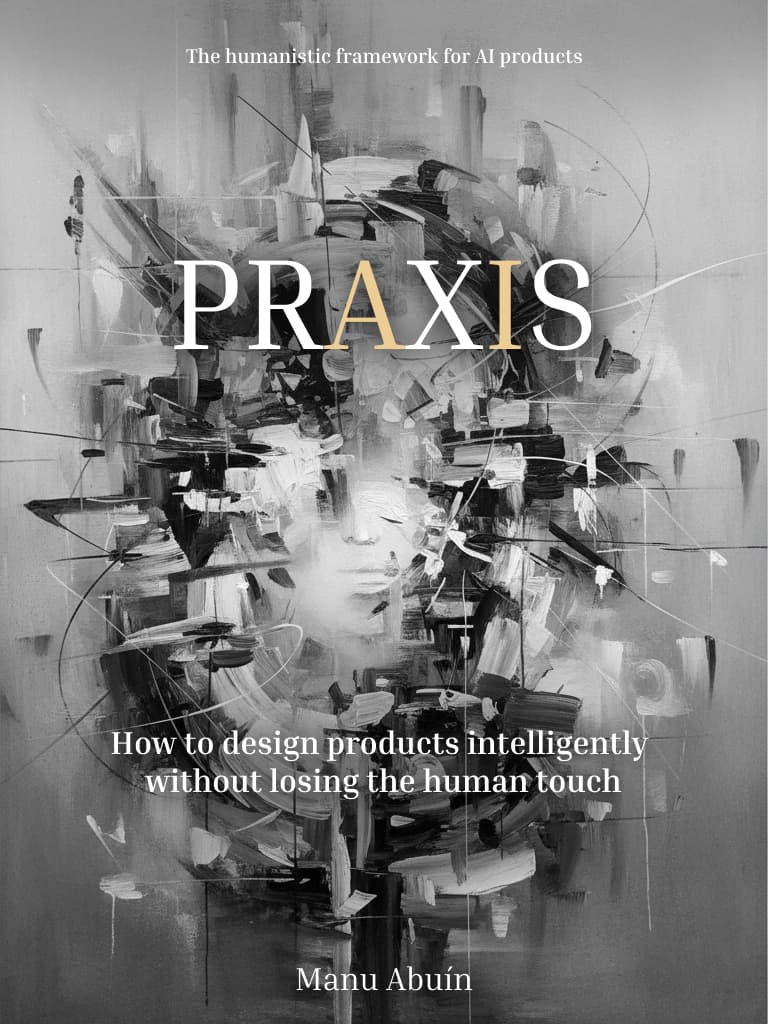
PRAXIS, the book
PRAXIS is the field manual for product leaders who refuse to choose between intelligent products and human dignity. Across seven parts, it builds a working language for AI delegation: where automation belongs, where it must yield, and how to design systems that reason without erasing the people they serve.
(Sample PDF coming soon. Leave your email and we'll send it.)